
Why retail packaging decides more than people think
In foot care, product innovation is rarely the biggest barrier to growth. Most brands already have solid formulations — heel balms that actually work, tallow creams with strong natural positioning, and intensive repair treatments that deliver results.
The real challenge happens much later in the journey: on the shelf.
Foot care is a low-involvement category in Australia. That said, consumers don’t spend time analysing ingredients or comparing technical differences. In most cases, they make a decision in a matter of seconds, based on what feels clear, credible, and easy to trust.
That makes packaging one of the most important commercial assets in the entire product system.
Retail packaging is not just about appearance. It directly influences whether a product is noticed, understood, and ultimately purchased.
What “retail-ready packaging” actually means
Retail-ready packaging is often misunderstood as “better design” or “premium aesthetics”.
In reality, it is a conversion system for retail occasions.
It needs to perform across four layers:
- Shelf visibility (can it be seen quickly?)
- Product clarity (is it instantly understood?)
- Trust building (does it feel credible?)
- Purchase conversion (does it get picked up?)
If packaging fails any of these stages, it loses the sale long before marketing or formulation comes into play.
The 3-second shelf rule: winning attention instantly

picture from Amazon
In a retail environment, consumers don’t read — they scan.
Most decisions happen within 3 to 5 seconds, which means packaging has to communicate instantly.
Clear product hierarchy
The first job of packaging is to answer three questions without effort:
- What is this product?
- What does it do?
- Why should I choose it?
This means the front-of-pack structure matters more than decoration.
A strong hierarchy typically includes:
- Product type (heel balm, foot repair cream, etc.)
- Core function (cracked heel repair, intensive hydration)
- Brand identity (secondary, not dominant)
If everything is competing for attention, nothing is communicated clearly.
Visual blocking and colour logic
Colour is often more powerful than text in retail environments.
Instead of treating design as decoration, successful brands use colour as a navigation system:
- Repair-focused products often lean toward clinical blues or clean neutrals
- Nourishing or natural formulas tend to use warm, earthy tones
- Intensive treatments benefit from stronger contrast and higher visual weight
The goal is not just beauty — it is instant recognition from distance.
Instant category recognition
One of the most common retail failures is simple: consumers can’t immediately identify what the product is.
If a shopper cannot tell within one second that a product is a foot care treatment, the packaging has already lost its job.
Clarity always outperforms complexity in retail environments.
Standing out in a crowded shelf environment
Foot care is a highly substitutable category. In most retail settings, products compete not because of dramatic differences, but because of perceived trust and clarity.
In this context, consumers tend to choose what looks most “reliable”, not necessarily what is technically superior.
Structural differentiation matters more than graphics
Design alone is not enough to differentiate on shelf.
Structural choices have a stronger impact, such as:
- Jar vs tube vs stick vs tin
- Pump vs standard closure
- Twist mechanism vs squeeze format
Structure is often the first thing a consumer subconsciously notices, even before reading anything.
Tactile experience influences perceived value
Once a product is picked up, physical interaction becomes part of the evaluation.
Key signals include:
- Weight (heavier often feels more premium)
- Surface finish (matte vs glossy)
- Opening experience (smooth vs flimsy)
These sensory cues directly influence how consumers interpret price fairness and product quality.
Clear positioning: clinical vs natural
One of the most important strategic decisions in foot care packaging is positioning clarity.
Brands typically fall into two directions:
- Clinical / repair-driven positioning
- Natural / wellness-driven positioning
The mistake many brands make is blending both signals, which creates confusion and reduces perceived authority.
Building trust through packaging design
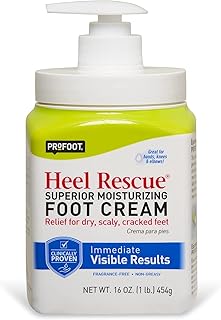
picture from Amazon
In retail, trust is not explained — it is inferred.
Consumers rarely verify claims at the shelf. Instead, they rely on visual cues to assess credibility.
Ingredient communication without visual overload
Effective packaging communicates key benefits without overwhelming the design.
Instead of listing everything, strong packaging focuses on:
- One primary benefit
- One supporting claim
- Clean, structured layout
Clarity builds more trust than information density.
Material choice signals product quality
Packaging material is often interpreted as a proxy for product quality:
| Packaging type | Consumer perception |
| Plastic jar | daily use / cost-effective |
| Glass jar | premium skincare |
| Aluminium tin | natural / handmade |
| Thin plastic tube | mass-market |
These associations happen subconsciously, which makes material selection a strategic decision, not just a technical one.
Avoiding visual noise
Over-designed packaging can actually reduce trust.
Common issues include:
- Too many fonts competing for attention
- Overly decorative graphics
- Mixed messaging across the pack
In retail, simplicity is often interpreted as confidence.
Retail environment optimisation
Good packaging must work in real-world conditions, not just in design mockups.
Shelf visibility across distance
Packaging must remain readable at a distance, not just up close.
This includes:
- Strong contrast
- Clear typography
- Simple composition
If it cannot be understood from a few steps away, it will underperform.
Consistency across product ranges
For brands with multiple SKUs, consistency is critical.
A strong system should:
- Maintain visual unity across the range
- Use colour or structure to differentiate functions
- Build long-term brand recognition on shelf
Lighting and material response
Retail lighting can significantly affect perception.
Glossy surfaces may reflect too much light, while low-contrast designs may disappear under bright store conditions.
Packaging must be tested under realistic retail lighting conditions, not just studio environments.
From packaging to purchase: reducing decision friction
Ultimately, retail packaging is not about communication — it is about conversion.
The easier it is for a consumer to decide, the higher the likelihood of purchase.
One product, one message
Each SKU should focus on a single clear promise.
For example:
- Intensive cracked heel repair
- Daily hydration and maintenance
- Natural tallow nourishment
Multiple competing messages dilute decision clarity.
Make selection effortless
Strong packaging reduces cognitive effort.
Instead of asking consumers to compare, it guides them toward an obvious choice.
Align packaging with price perception
Packaging must justify the price point visually.
If pricing is premium, packaging must reinforce that positioning. If pricing is mass-market, clarity and value perception become more important than luxury cues.
Technical constraints brands often overlook

image from Amazon
Retail success is not only about design — it also depends on technical execution.
Durability in real environments
Packaging must withstand:
- Transport pressure
- Shelf handling
- Warehouse stacking
Weak structures often fail after launch, even if they look good initially.
Heat stability and leakage control
Foot care products often contain oils and waxes, making them sensitive to temperature changes.
Without proper testing, issues such as softening, leakage, or separation can occur during shipping or summer fulfilment periods.
Manufacturing and scalability
Some designs look great in concept but fail in production due to:
- Filling limitations
- Sealing complexity
- Material incompatibility
Scalability should always be considered early in development.
Key takeaways for foot care brands
Retail-ready packaging is not a design exercise — it is a commercial system.
The most effective packaging:
- Communicates clearly in seconds
- Differentiates structurally, not just visually
- Builds trust through material and simplicity
- Performs reliably in real retail conditions
- Supports conversion, not just visibility
Final thoughts
The most successful foot care packaging is not the most decorative or complex — it is the one that gets understood instantly and chosen effortlessly.
In a crowded retail environment, clarity always outperforms decoration, and structure always outperforms styling.
Working with a packaging partner
Most packaging problems don’t appear during the design stage — they show up in production and real-world use.
- A heel balm that performs well in a pump format may become difficult to dispense when transferred into a different packaging style.
- A tube that seems convenient in concept can fail in practice if the opening is too large or too small for the product viscosity.
- A premium-looking design can also slow down filling lines, increase rejection rates, and quietly raise unit costs if it is not suitable for manufacturing.
- And an unreliable supplier with a low pass rate can delay — or even jeopardise — an entire launch plan.
These are not major design flaws, but small misalignments between formula behaviour, packaging structure, and real production conditions. The issue is they often only surface at scale, when changes are already costly and time-consuming.
This is why early-stage packaging thinking is critical.
Working with a packaging partner is not about selecting a more attractive bottle or jar. It’s about pressure-testing how your product performs across real manufacturing, shipping, and consumer use scenarios before you commit to full-scale production.
Getting this right early helps reduce rework, avoid costly production setbacks, and ensures your packaging performs consistently from factory line to retail shelf to end consumer experience.