
Introduction — Why Your Packaging Choice is a Brand Statement
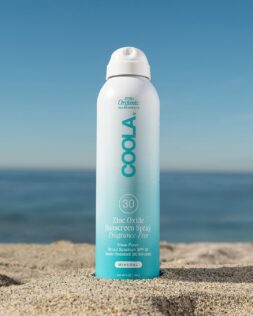
In the Australian sun care market, spray sunscreen is favored for its speed. However, for a brand, the choice between aerosol and non-aerosol is a core strategic decision. This choice dictates your formulation integrity, SPF efficacy, regulatory risk, and shipping logistics.
While these formats are often grouped together, they operate on fundamentally different mechanical principles. For Australian brands, selecting the right format is a balance between consumer “convenience” and the brand’s “trust equity.”
1. Aerosol Sunscreen: The “High-Activity” Format
Aerosol packaging uses a pressurized system to dispense sunscreen as a continuous, fine mist. This format is the industry standard for “sport” and “active” lifestyle positioning.
How it Works (and the Technical Reality):
- Propellant-Driven: The canister contains both the sunscreen formula and a propellant (typically LPG like butane or propane).
- The Dilution Factor: In standard aerosols, up to 40–50% of the spray is propellant, not sunscreen. Brands must account for this in user instructions to ensure consumers apply enough product to achieve the labeled SPF.
- Sealed Environment: The pressurized can prevents oxygen from entering, which can help stabilize certain chemical UV filters.
Strategic Applications:
- Sport & Beach Lines: Where “one-handed” and 360-degree application is a priority.
- Mass Retail: High consumer familiarity drives volume in traditional supermarkets and pharmacies.
2. Non-Aerosol (Pump) Spray: The “Integrity” Format
Non-aerosol packaging uses a mechanical pump to dispense product. As brands move toward “Clean Beauty” and mineral-based formulas, this format is becoming the preferred choice for premium and family-oriented ranges.
The Mechanical Edge:
- 100% Formula Delivery: Unlike aerosols, every gram dispensed is sunscreen. There is no propellant dilution, ensuring the user gets the exact SPF protection tested in the lab.
- Inhalation Safety: Pumps produce larger droplets (>10 microns) that are too heavy to be inhaled deep into the lungs. This is a significant safety advantage for children’s sunscreens.
- Airless Evolution: Premium non-aerosol sprays can use airless technology (piston-driven), which protects the formula from oxidation—essential for “preservative-free” or sensitive-skin claims.
Strategic Applications:
- Mineral & Zinc Formulas: Mechanical pumps handle high-viscosity “physical” sunscreens far better than aerosol valves, which are prone to clogging.
- Family & Baby Care: Prioritizing safety and controlled application over speed.
- D2C & E-commerce: Avoiding “Dangerous Goods” shipping restrictions.
3. Bag-on-Valve (BoV): The “Best of Both Worlds”
BoV is a hybrid technology. The sunscreen is sealed in a laminated bag inside the can, and compressed air or nitrogen is used in the space around the bag to squeeze the product out.
- Continuous Spray without the Gas: You get the 360-degree “continuous spray” consumers love, but with 100% pure formula hitting the skin.
- Separation of Product: The formula never touches the propellant or oxygen, extending shelf life and allowing for fewer preservatives.
- Non-Flammable: Because it uses compressed air/nitrogen instead of LPG, BoV products are often classified as non-flammable, simplifying storage and shipping.
- Best For: Premium brands that want “Aerosol performance” with “Pump integrity.”
Side-by-Side Comparison: Brand Decision Matrix
| Feature | Aerosol | Bag-on-Valve (BoV) | Non-Aerosol (Pump) |
| Minimum Order (MOQ) | High (Typically 50k+ units) | High (Typically 50k+ units) | Low to Medium (5k–10k) |
| Filling Equipment | Specialized “Gassing” lines | Specialized BoV lines | Standard liquid filling |
| Lead Times | Long (due to valve/can sourcing) | Medium to Long | Shorter / More flexible |
| HazMat Storage | Required (Class 2.1 Flammable) | Usually not required | Not required |
Production Note: Aerosol filling is a specialized niche. It requires explosion-proof rooms and high-speed machinery to be cost-effective. If you are a startup or a boutique brand, the 50,000-unit MOQ for both aerosols and Bag-on-Valve (BoV) is often the deciding factor that leads brands toward the more flexible Pump Spray format.
Sustainability & ESG Considerations
For Australian brands, sustainability is no longer an “extra”—it is a regulatory and consumer requirement.
- The Propellant Problem: Traditional aerosols contribute to a brand’s carbon footprint through volatile organic compounds (VOCs).
- The Recycling Reality: While aluminium aerosol cans are recyclable, the plastic valves are not. For Non-Aerosol pumps, brands should specify Mono-material Pumps (100% PP) to ensure the entire unit is kerbside recyclable in Australia.
- Bag-on-Valve (BoV) – The Middle Ground: If you want the continuous spray of an aerosol without the chemical propellants, BoV technology uses compressed air to squeeze the formula. It is the “gold standard” for brands wanting to bridge the gap between performance and sustainability.
Regulatory & Shipping: The Hidden Bottom Line
For Australian brands, logistics can eat your margins if you choose the wrong format.
- TGA Compliance: The TGA (Australia) closely monitors “over-spray” and application thickness. Non-aerosols offer more “visible” coverage, making it easier for brands to prove that users are applying the required $2mg/cm^2$ of product.
- E-commerce Returns: Shipping an aerosol via air or through standard post in Australia involves strict labeling and weight limits. Non-aerosols facilitate a much smoother “omni-channel” retail strategy.
- The “Wind” Factor: The TGA is increasingly aware that wind loss during aerosol application leads to sunburns. Non-aerosol pumps provide a more “visible” application, which helps brands defend their efficacy claims.
- Sustainability: To be truly “green,” brands should look for Mono-material Pumps. Traditional pumps have a metal spring that prevents recycling; mono-material PP pumps are 100% recyclable in Australian kerbside bins.
Summary Decision Matrix for Brand Owners
- Choose Aerosol if: You have high volume (50k+), a massive retail distribution, and your primary customer is an athlete who needs a “3-second spray.”
- Choose Non-Aerosol if: You are a D2C/E-commerce brand, you value 100% formula purity, you are launching a Mineral/Zinc line, or you want to start with lower MOQs.
- Choose Bag-on-Valve if: You want the premium “continuous spray” experience but want to avoid the safety and dilution issues of traditional gas propellants.
Why Partner with Primepac?
We help Australian SPF brands navigate these technical trade-offs from the formulation stage. Whether you are optimizing a Mineral Zinc spray for a mechanical pump or seeking Mono-material sustainability, we ensure your packaging reflects your brand’s commitment to safety, efficacy, and the environment.