
Introduction
In 2026, packaging material choice is no longer just a cost or design decision. It directly affects how easily packaging can be recycled, whether it aligns with Australian sustainability expectations, and how confidently brands can communicate their environmental claims.
Across Australia, pressure is growing from retailers, consumers, and regulatory frameworks to reduce packaging waste and improve recyclability. Brands are increasingly expected to consider not only how packaging looks and performs, but also what happens after use.
This is where the debate between mono-material and multi-layer packaging becomes important.
At a simple level, the choice often comes down to simplicity vs performance:
- Mono-material packagingis generally easier to recycle and simpler to manage from a compliance perspective.
- Multi-layer packagingcan offer stronger barrier protection, longer shelf life, and premium finishes — but often with added recycling complexity.
The right choice depends on your product, priorities, and how you balance performance with sustainability in today’s Australian market.
What Is the Difference Between Mono-Material and Multi-Layer Packaging?
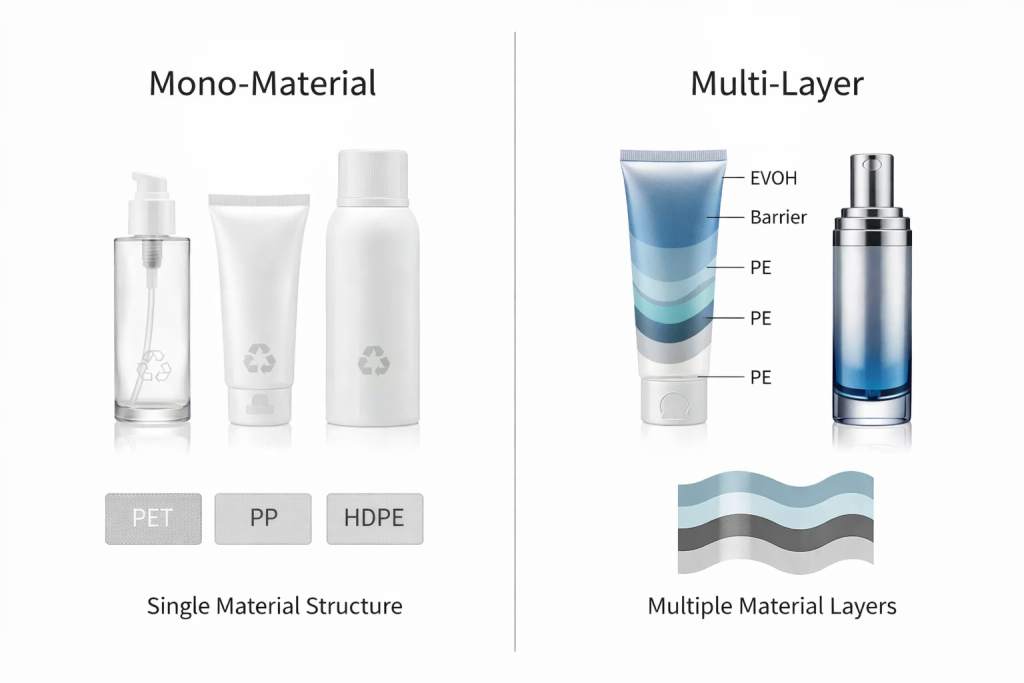
The difference comes down to how the packaging is constructed. Mono-material packaging is made primarily from one material family, such as all-PE or all-PP, which makes it easier to sort and recycle. Multi-layer packaging combines two or more materials — such as PET/PE, foil laminates, or mixed plastic systems — to improve performance such as barrier protection, durability, or shelf life.
In simple terms, mono-material focuses on recycling efficiency, while multi-layer focuses on product protection and functionality.
Quick Comparison
- Recyclability:
Mono-material packaging is generally easier to recycle through existing waste streams. Multi-layer packaging can be more difficult to process, depending on the materials used and local recycling capabilities. - Barrier Performance:
Multi-layer packaging usually performs better against oxygen, moisture, light, and contamination. Mono-material packaging may require product formulation support or design adjustments to achieve similar results. - Compliance Simplicity:
Mono-material structures are often simpler to review for recyclability, recycled content targets, and packaging compliance requirements. Multi-layer formats may require more technical assessment and supplier verification. - Use Case Fit:
Mono-material suits brands prioritising recyclability and simplified packaging systems. Multi-layer suits products needing higher protection or extended shelf life.
What Is Mono-Material Packaging?
Mono-material packaging is packaging made primarily from a single material family, such as PE, PP, or PET. Rather than combining different substrates, the main container and key components are designed to use compatible materials wherever possible.
This approach has gained momentum because it simplifies what happens after use.
Why It’s Preferred for Recycling
- Easier sorting:Packaging made from one material stream is easier to identify and separate in recycling facilities.
- Better recovery rates:Compatible materials are more likely to be successfully reprocessed into new packaging or products.
- Less contamination risk:Mixed materials can reduce recycling quality, while mono-material structures help maintain cleaner material streams.
- Simpler sustainability decisions:Brands can more easily align packaging with recyclability and recycled content goals.
In short, mono-material packaging is often preferred because it removes complexity — and in recycling, less complexity usually means better outcomes.
Common Mono-Material Packaging Examples
- All-plastic pump (mono PP/PE systems)
- Lotion pump bottles
- Serum pump bottles
- Airless bottles (mono PP systems)
- Plastic jars
- Deodorant sticks
- Mono-layer pouch (PE or PP)
- Mono-material tubes (PE tubes)
What Is Multi-Layer Packaging?
Multi-layer packaging combines two or more different materials within one structure to achieve performance that a single material may struggle to deliver on its own. This can include plastic laminates, foil layers, paper-plastic combinations, or mixed polymer systems.
Instead of relying on one substrate, each layer is designed to perform a specific role — such as strength, sealing, moisture protection, oxygen barrier, or visual appeal.
Why It’s Used
- Better barrier protection:Helps protect products from oxygen, moisture, light, and contamination.
- Longer shelf life:Commonly used for products that need freshness, stability, or extended storage time.
- Improved durability:Multiple layers can enhance puncture resistance, rigidity, or transport performance.
- Premium presentation:Decorative layers, coatings, and finishes can create a more premium shelf appearance.
- Specialised product needs:Often used where product sensitivity or performance requirements are higher.
Key takeaway: Multi-layer packaging is popular because it delivers strong product protection and presentation benefits — but that added performance often comes with more material complexity.
Common Multi-Layer Packaging Examples
- Multi-layer pouch (PET/PE, foil laminates)
- Multi-layer tubes (ABL / PBL)
- Decorated cosmetic bottles with coatings or sleeves
- Barrier-enhanced airless systems
Key Differences: Mono vs Multi-Layer Packaging
There is no universal “better” option. The right choice depends on whether your priority is recyclability, recycled content, product protection, or brand presentation.
Recyclability
Mono-material packaging is generally easier to sort and process through existing recycling streams because it uses one compatible material family.
Multi-layer packaging can be more challenging. Recyclability often depends on:
- how the layers are bonded
- whether materials can be separated
- local recycling capabilities
- overall packaging design
This is especially relevant in Australia, where brands are under growing pressure to improve packaging recovery outcomes.
In simple terms: Mono-material usually offers a clearer path to recyclability.
Recycled Content Integration
Mono-material systems often make it easier to introduce post-consumer recycled (PCR) content because the material stream is simpler and easier to manage.
With multi-layer packaging, recycled content can become more complicated due to:
- mixed materials
- barrier layers
- adhesives and coatings
- varying supplier inputs
This can reduce the effective recycled content percentage or create sourcing challenges.
In simple terms: Mono-material often simplifies recycled content targets.
Performance & Barrier Protection
This is where multi-layer packaging often has the advantage.
By combining different materials, multi-layer structures can provide stronger protection against:
- oxygen
- moisture
- light
- contamination
Mono-material packaging can still perform well, but may require:
- stronger packaging engineering
- thicker gauges
- supportive product formulation
- shorter shelf-life expectations in some cases
In simple terms: Multi-layer usually wins when product protection is the top priority.
Design & Branding Flexibility
Multi-layer packaging can offer greater freedom for premium aesthetics, including:
- metallic effects
- decorative laminates
- soft-touch finishes
- enhanced print surfaces
Mono-material packaging may require smarter design decisions to achieve a premium look while staying within one material family.
That often means using:
- better structural design
- strong branding graphics
- texture or embossing
- simplified premium styling
In simple terms: Multi-layer can be easier for visual impact, while mono-material rewards smarter design choices.
Packaging Type Breakdown
The mono-material vs multi-layer decision often depends on the packaging format itself. Some categories are naturally easier to simplify, while others require more technical trade-offs between performance and recyclability.
Bottles & Pumps
Bottles are often straightforward to convert into mono-material formats, but pumps can add complexity.
- All-plastic pumpsare becoming more common and can improve recyclability compared with traditional pumps that use metal springs and mixed materials.
- Mixed-material pumpsmay still offer proven performance, but often create more separation challenges after use.
- Lotion and serum pump bottlesneed to balance user experience, dosage control, leak prevention, and sustainability goals.
- Airless bottles:Mono PP airless systems are growing in popularity, while traditional mixed-material airless packs may still offer higher technical performance in some applications.
Jars & Sticks
These formats are often good candidates for mono-material solutions, but closures and mechanisms still matter.
- Mono-material jarsin PP or PET are widely used for creams, balms, supplements, and personal care products.
- Compatible lids help keep the overall system simpler.
- Deodorant stickscan be more complex due to internal twist mechanisms, moving parts, and fit tolerances.
Flexible Packaging
Flexible packaging is one of the biggest battlegrounds in sustainable packaging.
- Mono-layer pouchesusing PE or PP can improve recyclability and reduce material complexity.
- Multi-layer pouchesoften deliver stronger barrier protection and shelf-life performance, especially for food, powders, or sensitive products.
Tubes
Tubes are evolving quickly as brands push for more recyclable formats.
- Mono-material tubesare commonly PE-based and designed to simplify recycling streams.
- Multi-layer tubesoften use:
- ABL (Aluminium Barrier Laminate)for stronger barrier performance
- PBL (Plastic Barrier Laminate)for lighter weight and different sustainability options
When to Choose Mono-Material vs Multi-Layer
There is no automatic winner. The right choice depends on your product requirements, brand priorities, and commercial goals.
Some brands should prioritise recyclability and supply chain simplicity. Others need stronger barrier performance or premium shelf impact.
Choose Mono-Material When
- Recyclability is a priority
If improving recovery outcomes and reducing material complexity is a key goal, mono-material formats usually offer the clearest path. - You operate in high-volume FMCG or cosmetics
Large production runs often benefit from simpler packaging systems that are easier to source, standardise, and communicate. - A simplified supply chain is needed
Using fewer material types can reduce sourcing complexity, improve consistency, and make packaging decisions easier to manage. - You want easier recycled content integration
Mono-material systems can make it easier to introduce PCR materials over time.
Best fit: Everyday products, refill systems, mass retail packaging, and brands prioritising sustainability progress.
Choose Multi-Layer When
- Your product requires high barrier protection
Sensitive formulas may need stronger resistance to oxygen, moisture, or light. - Shelf life is critical
Longer storage periods, transport demands, or export distribution can make barrier layers commercially valuable. - Premium positioning is key
Decorative finishes, luxury feel, and high-end presentation are often easier to achieve with more complex structures. - Packaging performance outweighs material simplicity
For some products, preventing spoilage or maintaining formula integrity matters more than simplified recyclability.
Best fit: Premium skincare, specialist formulas, export products, and shelf-life sensitive categories.
Common Mistakes Brands Make
Many packaging decisions start with good intentions, but small assumptions can create bigger problems later. Here are some of the most common mistakes brands make when choosing between mono-material and multi-layer packaging.
Assuming Mono-Material = Automatically Recyclable
Using one material family is often a positive step, but it does not guarantee recyclability.
Real-world outcomes still depend on:
- local recycling capabilities
- labels, closures, and attachments
- contamination after use
Key point: Mono-material improves the opportunity for recycling, but design details still matter.
Ignoring Pumps, Caps, and Labels
Brands often focus on the bottle, jar, or pouch and overlook smaller components.
However, pumps, caps, sleeves, labels, and adhesives can significantly affect:
- sorting efficiency
- material compatibility
- consumer disposal behaviour
- overall recyclability outcomes
Key point: Small components can change the result of the entire pack.
Using Overseas Packaging Formats in the Australian Market
A packaging format that works in another country may not perform the same way in Australia.
Differences may include:
- recycling infrastructure
- retailer expectations
- sustainability frameworks
- consumer disposal habits
Key point: Imported packaging decisions should always be reviewed for local suitability.
Coatings & Full-Body Decorations: Balancing Visual Impact and Recyclability
Some coatings and full-body decorations can affect how packaging is sorted and recycled — for example, by limiting material detection, introducing additional material layers, or impacting the quality of recycled output, particularly when they are not easily removable.
At the same time, decorative finishes play an important role in branding and shelf appeal. The focus isn’t on removing them, but on applying them in a way that supports both your design intent and real-world recycling outcomes.Examples include:
- Full-body shrink sleeves (especially non-removable types)
- Heavy metallic inks or foils
- Functional barrier coatings
- Labels, adhesives, and laminated decorative films
- Coloured or opaque materials
Why They Matter for Recycling
These features don’t automatically make packaging non-recyclable, but they can influence how effectively it is sorted and processed:
Visibility during sorting: Full-body sleeves or heavy inks can make it harder for systems to identify the base material
Material combinations: Certain coatings or finishes may introduce additional layers or components
Processing outcomes: Some inks, adhesives, or decorative elements can affect the quality of recycled material if overused
Separation after use: Non-removable elements can limit how easily different parts of the packaging are handled
In practice, it’s not about whether decoration is used — but how it’s applied.
Conclusion
There is no single “perfect” choice between mono-material and multi-layer packaging.
Mono-material can support simpler recycling outcomes, while multi-layer can offer stronger barrier performance and premium presentation.
The right decision comes from balancing total system performance — including product protection, sustainability, customer experience, and commercial practicality.
The smartest brands don’t choose trends. They choose what works best for the product.
Need Support Choosing the Right Packaging Structure?
Primepac provides end-to-end packaging support, helping brands from early decision-making through to supplier alignment, production follow-up, and compliance verification.
We help align:
- Packaging structurewith product needs
- Material choiceswith performance and sustainability goals
- Suppliersfor consistency, timing, and smoother production
If you’re planning a new packaging project or reviewing your current format, Primepac can help simplify the process and keep your project moving with confidence.